Royalty
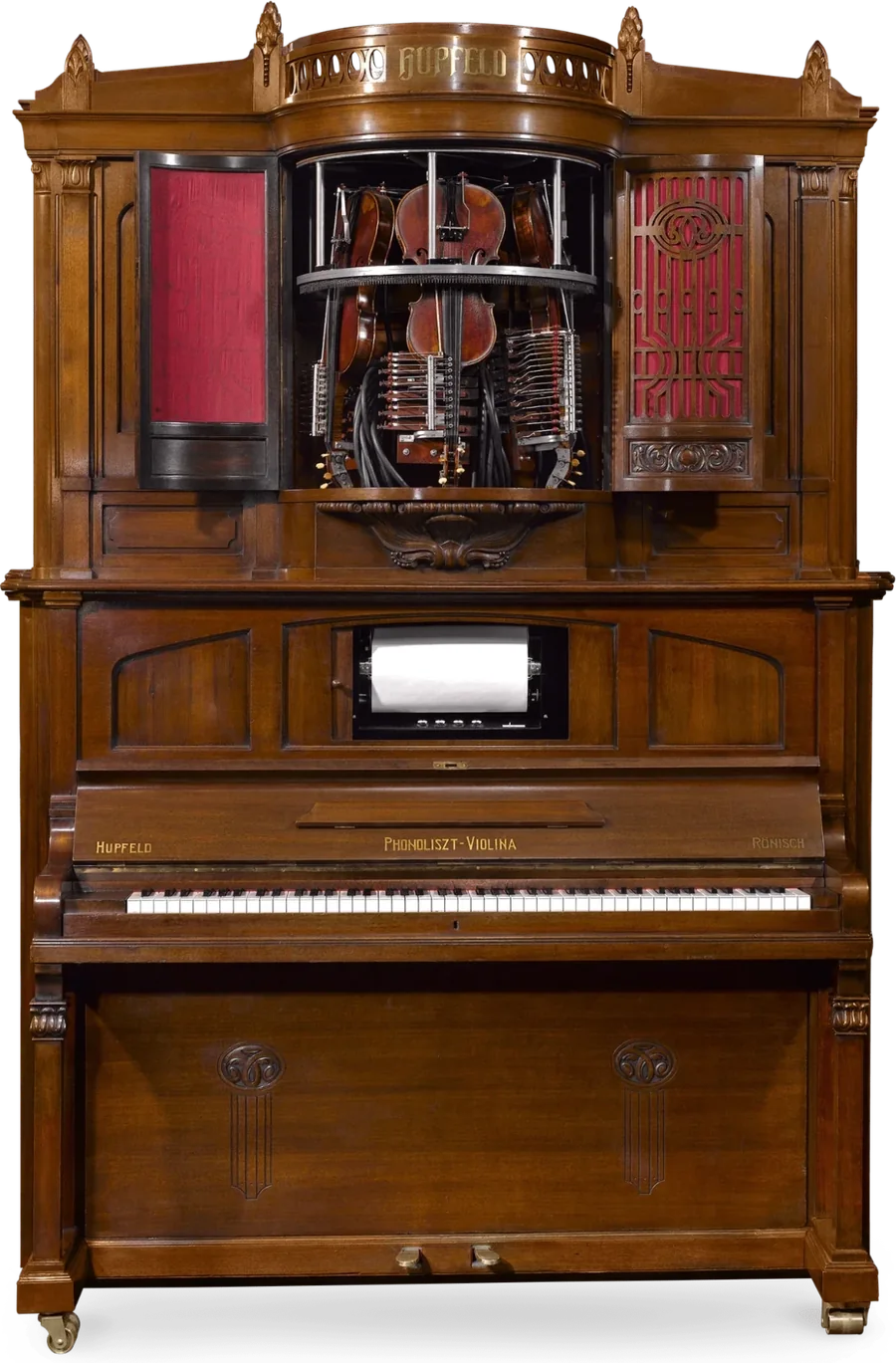
Hupfeld's Phonoliszt-Violina, Leipzig 1908: a piano coupled to three upright violins, bowed by a turning ring of some 1,300 horsehair threads and fingered by small bellows, all of it reading a perforated paper roll. The roll carried one performance into rooms the player would never enter. Once work could be replayed, payment had to replay with it. Hupfeld Phonoliszt-Violina, Leipzig; violin mechanism invented 1907, marketed from 1908, and shown at the 1910 Brussels World's Fair. Around 900 rolls were cut; some 63 instruments survive. The same rolls forced the question in law: White-Smith v. Apollo (1908) held that a roll was not a copy, and the Copyright Act of 1909 answered with the mechanical royalty — owed for the reproduction, not the performance.
Turn contributions into royalties.
The first artifact kept its record. The second kept its maker. The third will pay its maker again, as royalty settlement rolls out. XnY Protocol keeps all three for data: where it started, who added value, what stays private, and, as royalty settlement rolls out, how contributors will be paid every time it is used.